Brain Power - When Nothing is Broken Yet Everything is Shifting
Non-member post. For educational purposes only. Written by Sarah Parkins. Published on April 6, 2026.
This article is for those who continue to perform at a high level under sustained pressure, yet sense that something in their thinking, clarity, or energy has subtly shifted. The brain is highly energy-dependent, and while output can remain strong, the quality of thinking can quietly change - decisions compress, recovery is less complete, and clarity takes more effort. Over time, these shifts shape direction, making it less about capability and more about the conditions the brain is operating within.
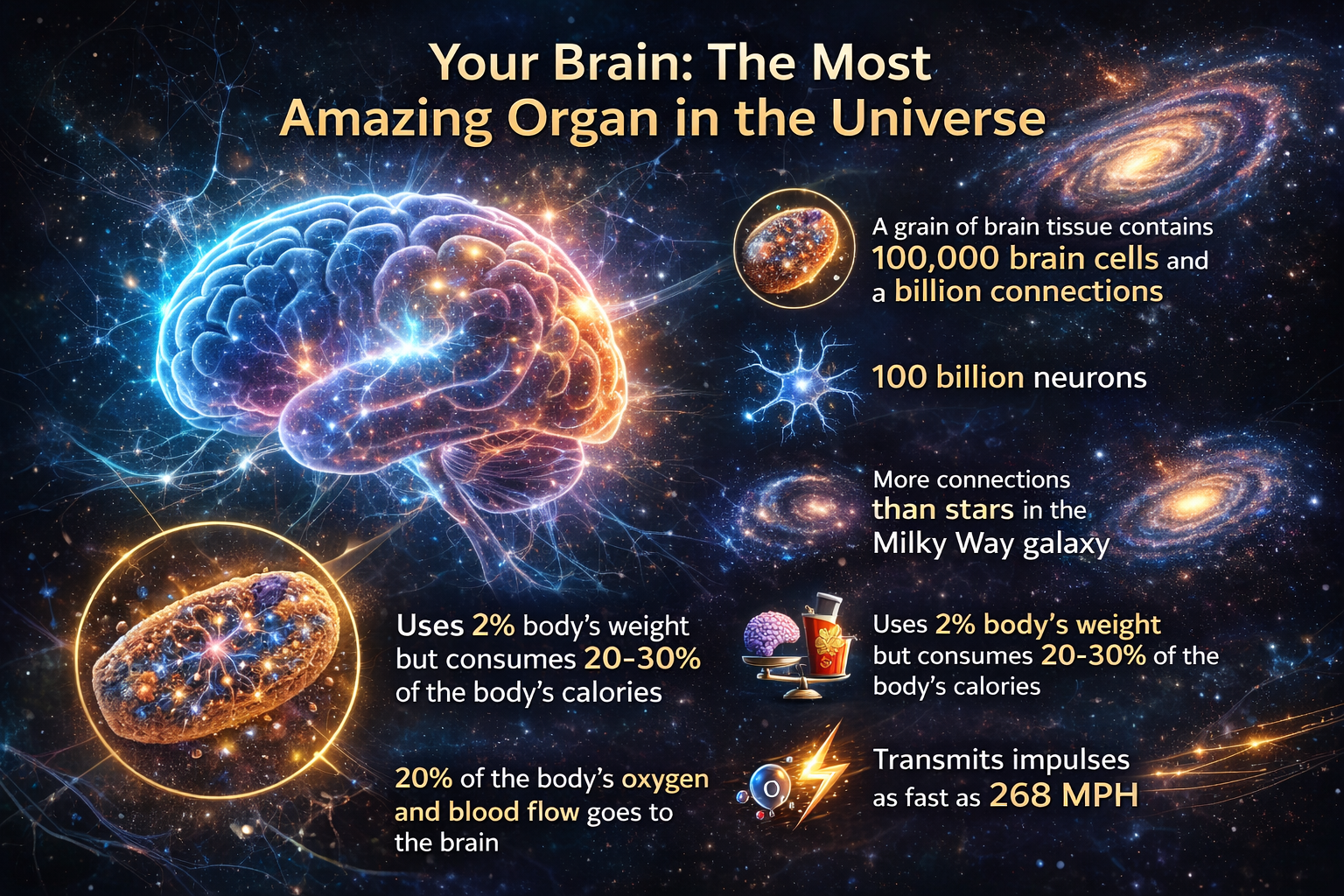
The System Behind Everything
The brain represents roughly 2% of body weight, yet consumes up to 30% of the body’s energy. On the surface, that’s an interesting statistic. In practice, it’s a signal. The system responsible for thinking, decision-making, and judgment is one of the most energy-dependent systems you have, and yet it is often the least deliberately managed.
The Assumption That Fails Under Pressure
Most high performers operate with an implicit assumption: that their thinking remains constant, regardless of pressure. As long as they are still performing - meeting deadlines, making decisions, carrying responsibility - the system behind that performance is assumed to be functioning in the same way it always has. But it isn’t.
When Performance Stays High but Thinking Changes
One of the more nuanced realities of sustained pressure is that performance can remain high for a long time. Externally, very little appears to change. Work gets done, outcomes are delivered, standards are maintained. Which is precisely why the shift often goes unnoticed. Because the change doesn’t first show up in output. It shows up in the quality of thinking that produces that output.
What Begins to Shift
Under sustained load, the brain adapts. Not dramatically, and not all at once, but in ways that are meaningful over time. Clarity begins to require more effort than it once did. Decisions are made slightly faster, with less space around them. Tolerance for ambiguity narrows. Patience becomes less available. Recovery happens, but not quite to the same depth. None of this is immediately alarming. Much of it can be rationalised as part of a demanding period or a natural consequence of responsibility. But these are not random changes. They are responses.
Why It’s Easy to Miss
What makes this particularly important is how subtle it is. There is rarely a clear moment where something feels definitively off. No obvious break, no sharp decline. Instead, it accumulates. A slightly shorter pause before a decision. A reduced willingness to sit with uncertainty. A gradual preference for what is known, rather than what requires deeper consideration. Over time, these small shifts begin to shape direction. Time horizons shorten. Decisions become more reactive. There is a greater reliance on familiar patterns rather than a full range of thinking.
Why It Matters
This matters because leadership is not simply about action; it is about judgment. And judgment is only as good as the conditions the brain is operating within. When those conditions change, even subtly, so does the quality of that judgment. The external picture can still look strong - often it does - but internally, the margin is different.
The Part Most People Notice Too Late
Nothing has to break for outcomes to begin shifting. In fact, by the time something feels obviously off, energy drops, sleep becomes disrupted, focus becomes inconsistent. The underlying change has often been in motion for some time. This is why many people only address it later than is useful.
A Different Way to Look at It
This is not a question of resilience, capability, or how much you can handle. It is a question of conditions. What are you asking your brain to operate within, day after day? What is the balance between load and recovery, between intensity and restoration, between output and the capacity that supports it? The brain will adapt to whatever conditions it is given. The only question is whether those adaptations are supporting the quality of thinking you rely on, or gradually constraining it.
The Earlier Adjustment
The most effective leaders don’t wait for something to break. They notice earlier. Not in a reactive way, but in a calibrated one. They recognise when clarity feels different, when decisions feel slightly more compressed, when the internal range they rely on begins to narrow, and they adjust the conditions accordingly. Not to do less, but to ensure that what they are doing continues to be driven by the level of thinking required.
In the End
The brain is not just another system to push harder. It is the system through which everything else is filtered. And while it is extraordinarily capable, it is also responsive - to pressure, to energy availability, and to how it is being used. Which means the question is not simply how much you can sustain, but what quality of thinking you are sustaining it with.
If you’re wondering how to begin optimizing your brain health, you can start today. Book a consult and find out how.
Disclaimer: The information and services provided by Birch Cove are for educational purposes only and are not a substitute for professional medical advice, diagnosis, or treatment. Birch Cove is not a medical provider and does not treat, cure, or prescribe for any medical conditions unless otherwise stated. Always consult your physician or qualified healthcare provider with any medical concerns. Birch Cove assumes no liability for actions taken based on the provided information or services. Product links may be affiliate links, meaning Birch Cove could receive a small commission on purchases.