Non-member post. Unprompted and unsponsored. Published Nov 11, 2026. For educational purposes only. This is not medical advice. Please consult your healthcare provider for all your health needs.
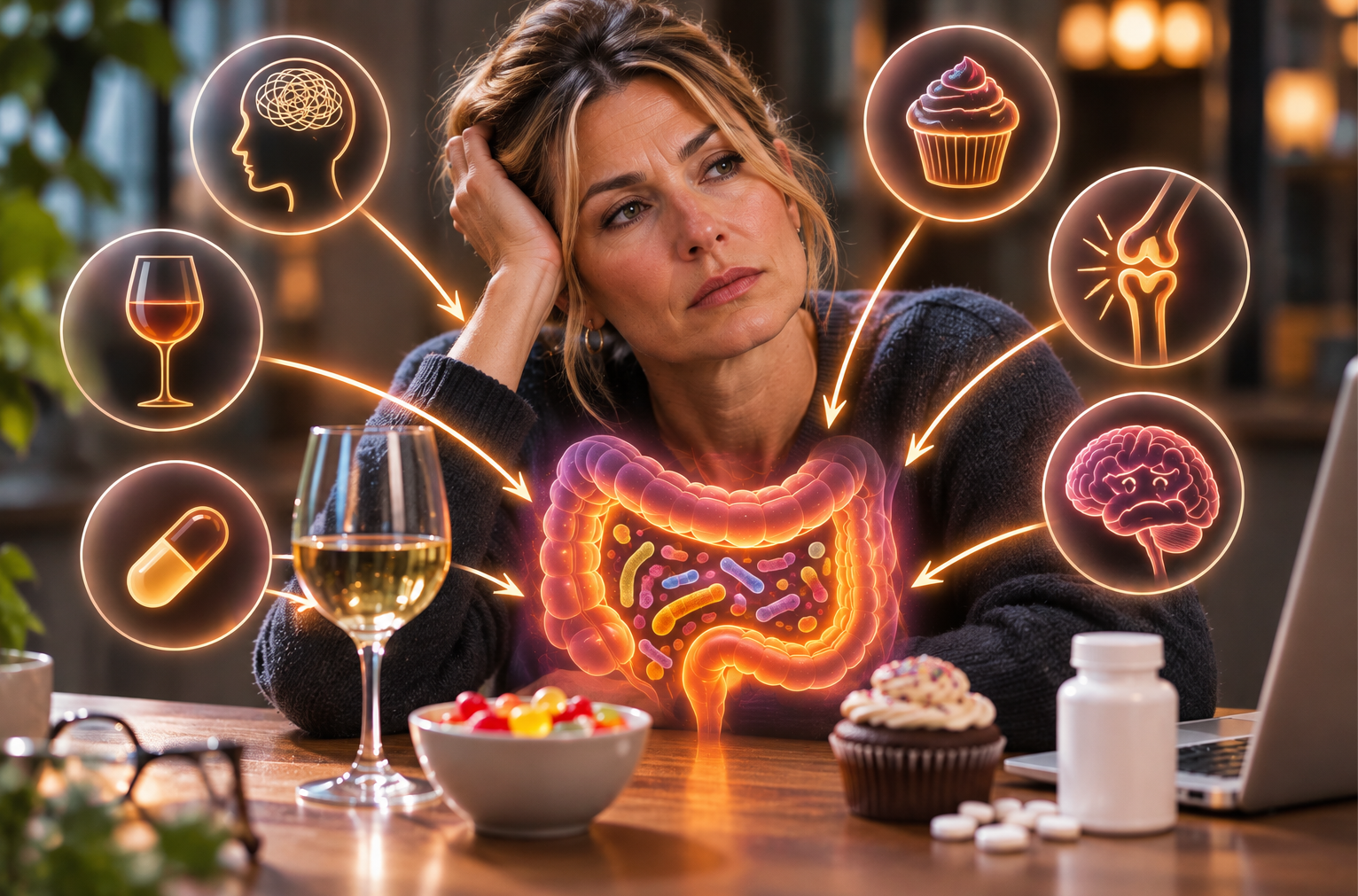
Meet Claire.
Claire had a rough day at work. She came home wound up, poured herself a glass of wine, then poured another. It’s a story familiar to many of us.
Nothing about that evening was unusual. But it became a pattern, and over the next few months a lot of small, ordinary choices started to add up in ways Claire never saw coming.
Drink: Here’s what Claire didn’t realize. Research shows alcohol can disrupt the balance of bacteria in the gut, and those bacteria do a lot for her. They help her digest her food, look after her gut lining, support her immune system and even communicate with her brain. One glass wasn’t the issue. A glass or three every night for months was.
Stress: Claire got so used to the stress that she didn’t notice she was on high alert to everything in her life. Stress raises cortisol, and cortisol raises blood sugar. Studies have found that people who release more cortisol under stress tend to eat more sweet food, so no wonder Claire was reaching for dessert. The trouble is that a diet high in sugar can reduce the variety of bacteria in the gut and shift the balance toward bacteria linked with inflammation.
Aches: A few months in, Claire was sore and tired all the time. She put it down to a busy season at work and getting older. But gut bacteria play a central role in the immune system and in inflammation, and research links gut health to the skin as well. When the gut is under strain, many people feel it well beyond their stomach.
Sickness: Claire kept catching colds and getting stomach bugs. That’s no coincidence: research shows people under more psychological stress are more likely to catch a cold. She tried to push through, kept working and took over-the-counter medicines, but she still ended up taking days off. Each sick day added to her workload, and that added to her stress. It became a cycle.
Quick fixes: So Claire did what many of us do. She kept taking anti-inflammatory painkillers most days just to keep going. When she got sicker, she needed antibiotics. All of these have their place, and sometimes they’re exactly what’s needed. But regular use of anti-inflammatory painkillers can weaken the gut’s protective barrier and lead to low-grade inflammation. Antibiotics clear out helpful bacteria along with harmful ones, and the gut doesn’t always fully bounce back. Claire’s gut was already struggling, and now it was taking more hits.
Mood: Before long, her mood dipped. She wasn’t sleeping well, she felt flat, and she couldn’t work out why. She shopped, she drank, she experimented with recreational drugs, she booked expensive weekend trips. Anything to feel a bit better. The gut and brain are in constant conversation through what’s called the gut-brain axis, using nerves, the immune system and chemical messengers. Much of the body’s serotonin, the chemical best known for its link to mood, is made in the gut with help from gut bacteria. So when Claire’s gut was off balance, it makes sense that her mood went with it.
Getting help: Eventually Claire asked for help. She worked with her doctor and a health coach and began making changes she could actually stick with:
She swapped her nightly wine for a walk or a call with a friend most evenings.
She added more vegetables, beans and other fiber-rich foods, which feed the helpful gut bacteria.
She cut back on sugar, especially after dinner.
She had blood tests to check her levels and began taking supplements to replenish what was low.
She began processing her grief for the life she once thought she’d live.
She started going to bed earlier and kept a more regular sleep schedule.
None of it happened overnight. Over time her body began to repair and find its balance again, and she started to feel like herself.
What Claire’s story shows
Claire isn’t a real person, but at Birch Cove we hear versions of her story all the time.
Stress, alcohol, sugar, pain, getting sick, poor sleep and low mood can feel like separate problems. Often they’re connected, and they feed into each other. People reach for whatever gets them through a hard day, and they rarely connect it to how they feel three months later.
The good news is that the same connections work in reverse. Lowering stress makes it easier to cut back on sugar. Fiber-rich food feeds the helpful bacteria in the gut. A healthier gut supports the immune system and the gut-brain connection. The body can repair. It takes time, effort and commitment.
Where Birch Cove comes in
As a health coach, Sarah helps busy people see these patterns and shift the habits behind them in a way that fits their real lives. She works alongside your medical care, not in place of it.
If Claire sounds a bit familiar, get in touch or book a session.
Further Reading
Understanding the science relating to this story is important. If you’d like to dig in further, here are a series of peer-reviewed studies to begin exploring.
Bishehsari F, Magno E, Swanson G, et al. Alcohol and gut-derived inflammation. Alcohol Research: Current Reviews. 2017;38(2):163–171. https://pubmed.ncbi.nlm.nih.gov/28988571/
Engen PA, Green SJ, Voigt RM, Forsyth CB, Keshavarzian A. The gastrointestinal microbiome: alcohol effects on the composition of intestinal microbiota. Alcohol Research: Current Reviews. 2015;37(2):223–236. https://pmc.ncbi.nlm.nih.gov/articles/PMC4590619/
Kuo T, McQueen A, Chen TC, Wang JC. Regulation of glucose homeostasis by glucocorticoids. Advances in Experimental Medicine and Biology. 2015;872:99–126. https://escholarship.org/uc/item/9f7815hn
Epel E, Lapidus R, McEwen B, Brownell K. Stress may add bite to appetite in women: a laboratory study of stress-induced cortisol and eating behavior. Psychoneuroendocrinology. 2001;26(1):37–49. https://pubmed.ncbi.nlm.nih.gov/11070333/
Satokari R. High intake of sugar and the balance between pro- and anti-inflammatory gut bacteria. Nutrients. 2020;12(5):1348. https://www.mdpi.com/2072-6643/12/5/1348
Belkaid Y, Hand TW. Role of the microbiota in immunity and inflammation. Cell. 2014;157(1):121–141. https://pubmed.ncbi.nlm.nih.gov/24679531/
Salem I, Ramser A, Isham N, Ghannoum MA. The gut microbiome as a major regulator of the gut-skin axis. Frontiers in Microbiology. 2018;9:1459. https://pmc.ncbi.nlm.nih.gov/articles/PMC6048199/
Cohen S, Tyrrell DAJ, Smith AP. Psychological stress and susceptibility to the common cold. New England Journal of Medicine. 1991;325(9):606–612. https://pubmed.ncbi.nlm.nih.gov/1713648/
Bjarnason I, Scarpignato C, Holmgren E, et al. Mechanisms of damage to the gastrointestinal tract from nonsteroidal anti-inflammatory drugs. Gastroenterology. 2018;154(3):500–514. https://pubmed.ncbi.nlm.nih.gov/29221664/
Dethlefsen L, Relman DA. Incomplete recovery and individualized responses of the human distal gut microbiota to repeated antibiotic perturbation. Proceedings of the National Academy of Sciences. 2011;108(Suppl 1):4554–4561. https://pmc.ncbi.nlm.nih.gov/articles/PMC3063582
Cryan JF, O’Riordan KJ, Cowan CSM, et al. The microbiota-gut-brain axis. Physiological Reviews. 2019;99(4):1877–2013. https://doi.org/10.1152/physrev.00018.2018
Yano JM, Yu K, Donaldson GP, et al. Indigenous bacteria from the gut microbiota regulate host serotonin biosynthesis. Cell. 2015;161(2):264–276. https://pubmed.ncbi.nlm.nih.gov/25860609/
Makki K, Deehan EC, Walter J, Bäckhed F. The impact of dietary fiber on gut microbiota in host health and disease. Cell Host & Microbe. 2018;23(6):705–715. https://doi.org/10.1016/j.chom.2018.05.012
Disclaimer: The information and services provided by Birch Cove are for educational purposes only and are not a substitute for professional medical advice, diagnosis, or treatment. Birch Cove is not a medical provider and does not treat, cure, or prescribe for any medical conditions unless otherwise stated. Always consult your physician or qualified healthcare provider with any medical concerns. Birch Cove assumes no liability for actions taken based on the provided information or services. Product links may be affiliate links, meaning Birch Cove could receive a small commission on purchases.