Whole Foods Is Selling the Things It Was Built to Refuse.
Non-member post. Unprompted and unsponsored. Published July 1, 2026. For educational purposes only. This is not medical advice. Please consult your healthcare provider for all your healthcare need
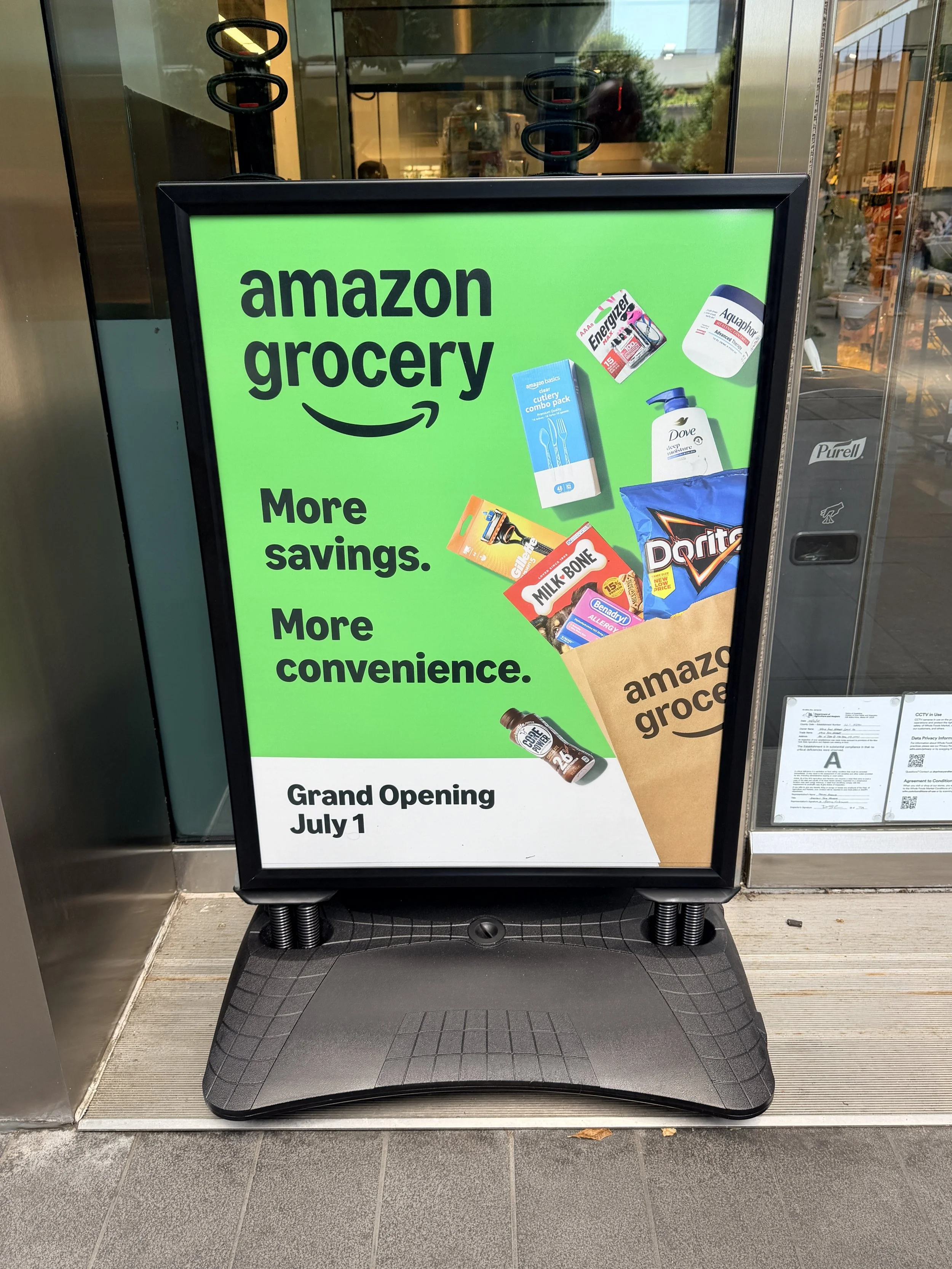
Manhattan West, Whole Foods Market, June 25, 2026
What happens to a brand, and a leader, when the reserves that held the line run out.
I paused as a sipped my coffee and noticed the bright green sign advertising Amazon grocery. Doritos. Coca-Cola. A pump bottle of Dove. Benadryl. A bottle of chocolate protein tumbling into a paper bag. Grand Opening, July 1. Above on a giant digital display the words: Amazon Grocery. Coming soon to the first floor of Whole Foods Market.
I stared at it longer than I meant to. Reflecting, trying to make head and tail of it. Because the products on that sign are, for the majority, the things Whole Foods spent four decades refusing to sell.
I have shopped at Whole Foods Market for twenty years, mostly in Manhattan, but around the U.S. too on various trips. For most of them, there was a small bounce in my step as I walked through the doors. A gratitude for being able to shop in a place that sold food I wanted, could afford, and had access to. A quiet confidence that I did not have to be extra vigilant, scouring shelves and labels, because the things I wanted were the things they stocked. Clean food. Real ingredients. Nothing I needed to turn over and interrogate. I could trust Whole Foods Market.
That feeling has thinned since the Amazon acquisition. Not all at once. A little each year. Now I read labels I never used to read. I put things back regularly. I pick through shelves that were once pre-sorted for me by someone else's standards. The produce too often looks tired and long-traveled, the kind that has spent its vitality in transit and arrived a little dimmed - like humans after a long haul flight. Something has been quietly traded away. If you have shopped here for years, you have felt it. I have watched it happen.
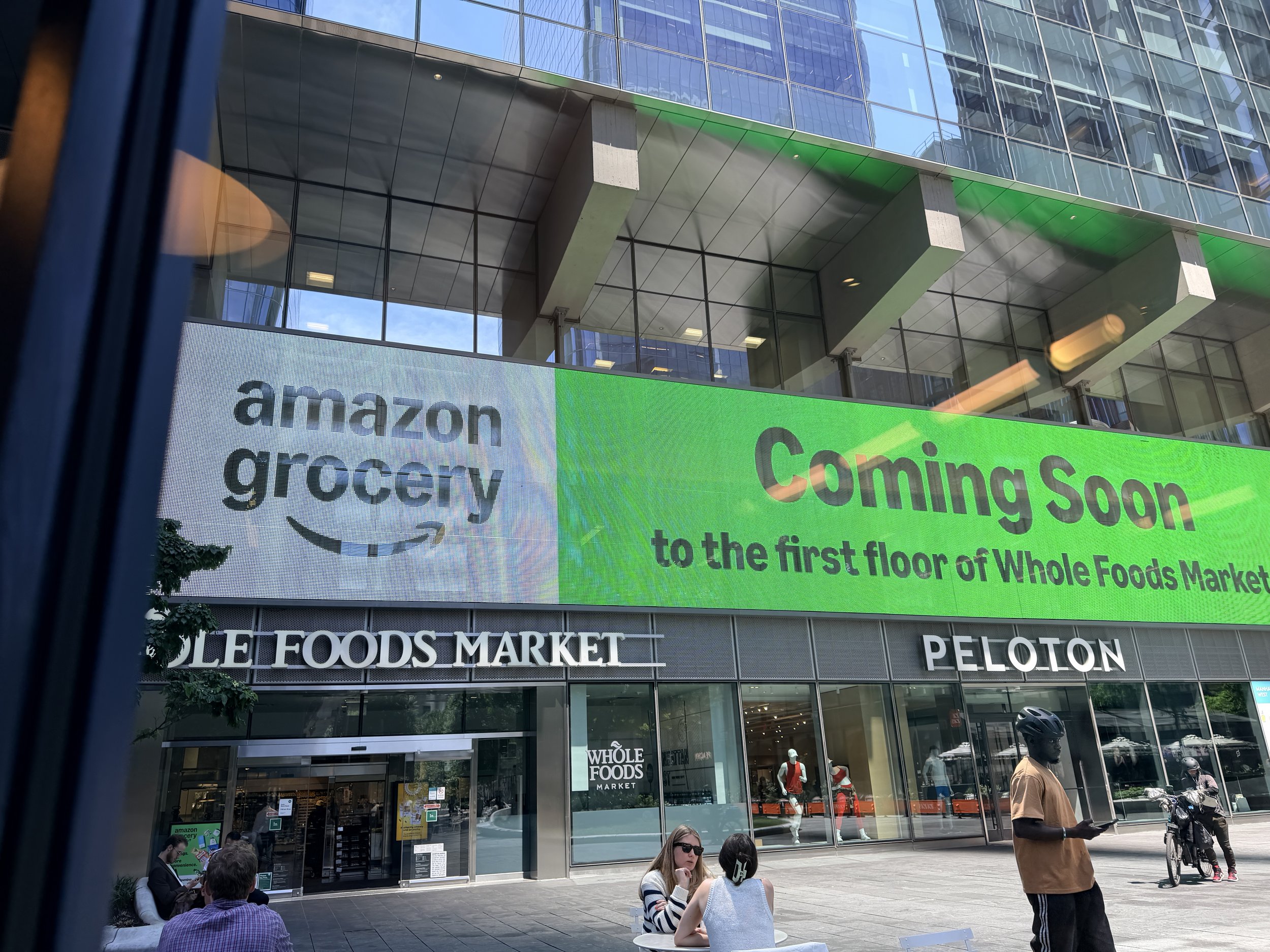
Manhattan West, Whole Foods Market, June 25, 2026
Here is the part that should give you pause. The prices came down. Amazon promised as much when it took over, cutting prices on staples from day one. But price and quality are not free of each other. You do not lower what you charge for carefully sourced food without eventually lowering what you ask of it, and the two have moved together. Good things are still there, sourced with real care. But more and more, to be sure of what I am buying, I go around the store rather than through it, scouring for the producers I trust. That is what it looks like when the middleman is no longer one you can rely on. The people who know the difference quietly start sourcing it themselves.
Here is what is happening, plainly. Amazon bought Whole Foods in 2017 for $13.7 billion, and Whole Foods has been a wholly owned Amazon subsidiary ever since. Amazon Grocery is the newer idea: a conventional store set down inside, or beside, the organic one. The first opened in Chicago in 2024. This is the second, at Manhattan West. It carries the national brands Whole Foods keeps off its own shelves because of its standards on additives and artificial sweeteners. Coca-Cola. Frito Lay. Kraft. The things you used to go to a different store for, now waiting by the door.
You do not have to take my word for the contradiction. Whole Foods wrote its own terms on the wall.
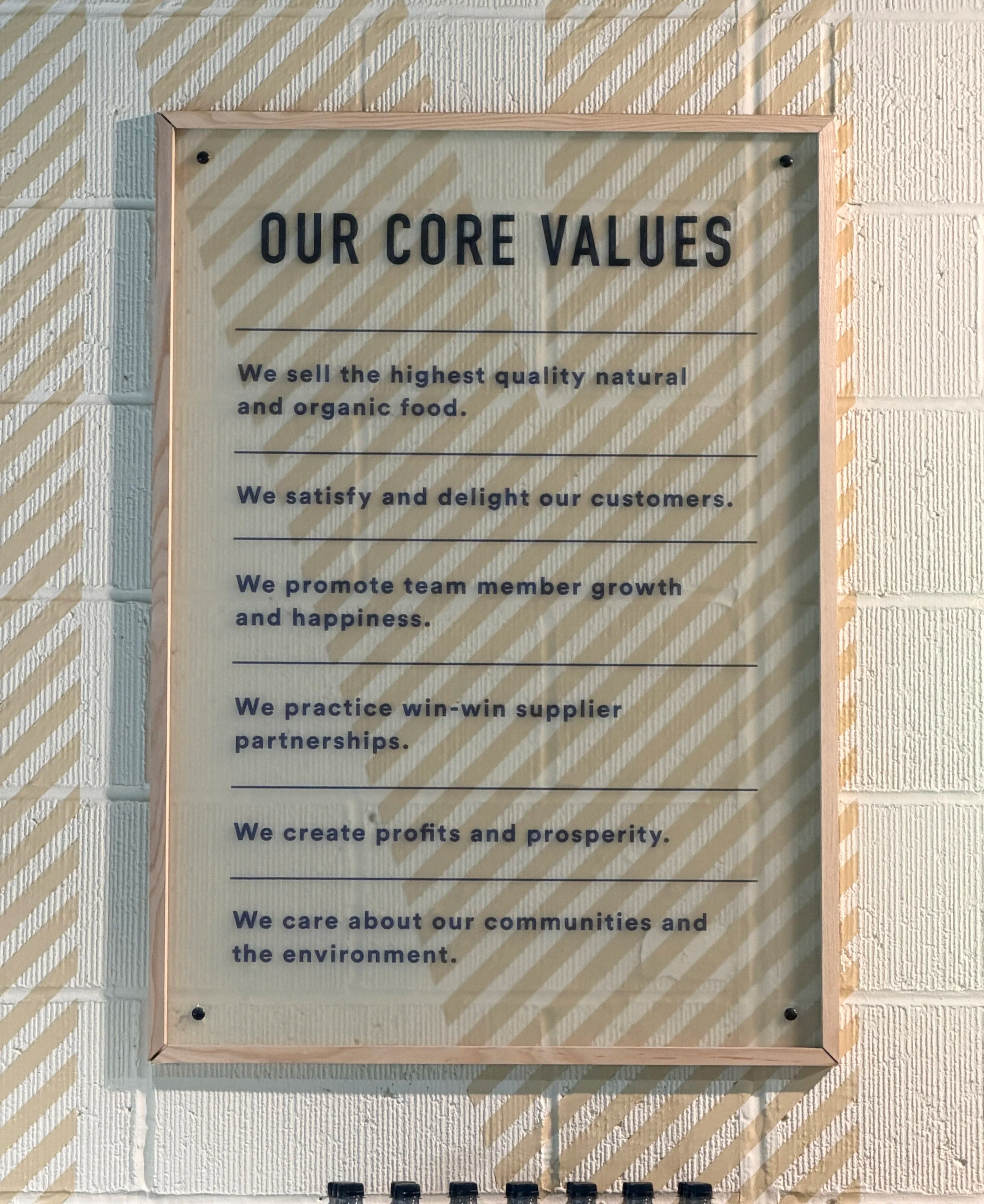
London, Chelsea. Whole Foods Market “Our Core Values” still plainly visible and proud in June 1, 2026.
Walk into some of the stores and you can still find a framed board, plain and a little earnest, titled “Our Core Values.” The first line reads: we sell the highest quality natural and organic food. Profit sits fifth on that list, not first. And the company has always insisted these values do not move. In its own words, they do not change from situation to situation, and they are lived in every single store across the world.
That was the promise, and it was never abstract. It was a filter. You did not have to read every label, because someone upstream had already read them and said no on your behalf. That no was the product. It was the whole reason you paid more and trusted what went into the bag.
Now the no is for sale one aisle over.
Here is the quiet tell. That values board is getting harder to find in the US stores. The clearest one I have seen lately was hanging in London. Companies do not hide what they are proud of. They hide what has started to frustrate them. When the values and the floor plan stop agreeing, one of them has to go, and it is almost never the floor plan.
And this would not be the first promise to go quiet. In 2013, Whole Foods became the first national grocer to pledge that every product containing genetically modified ingredients would be labeled, with a deadline of 2018. It called that a stand for your right to know. In 2018, less than a year after the Amazon deal closed, it paused the deadline and never set another. The labels never came. The right to know was shelved without a headline. That is usually how these things go. Not with a decision anyone announces, but with one nobody does.
The unease is not only out on the sidewalk. Talk to the people who work these floors and the contradiction comes up on its own. It cuts against what we are meant to stand for. There is a tension and a conflict that exists. It does not sit well. When the people inside a company feel the tension that is very real.
To be fair, the store is honest about what it is. It is labeled, it is separate, and for now a shopper still knows which standard applies where. But that separation is a floor plan, not a principle. Two inventories, one roof, one owner. The cost of sliding a single item across that line has fallen to almost nothing, and no one has to announce it when it happens. One conventional product appears on a Whole Foods shelf, then another, and you would not notice, because not having to notice was the whole point. The brand did the reading for you.
I am not saying that will happen but I would be happy to stand by my word and watch that occur, quietly, over the next few years. Why? The structure no longer prevents this from happening. What was once prevented by design is now prevented only by restraint, held by the same leadership that just decided restraint was too expensive. And once trust starts to leave, it takes the benefit of the doubt with it. People begin to assume the quiet trade could happen on the shelves too, and that suspicion is a cost by itself. It needs no product to actually cross the line. The expectation of the quiet move is now part of what the brand carries.
There is a human cost underneath all of this, and it is the part I sit with most. We do not need another bright, well-lit doorway pushing high-sugar, heavily processed food at the people walking past it. We need fewer. And to run that food through the one national name that was built to mean the opposite is not neutral. It borrows a reputation earned through restraint and spends it on the very thing the restraint was there to keep out. People trust that green sign with what they put in their bodies. That trust is not a marketing asset to be drawn down. It is the thing itself.
So here is what I think matters, for anyone leading anything. Integrity is not what you protect once the numbers are safe. It is what makes the numbers last. Real shareholder value sits downstream of what you refuse to sell. Leaders are paid to hold that line in exactly the quarter that makes it inconvenient.
It is tempting to call the failure greed and be done with it. But I work with leaders, and greed is almost never the real story. Depletion is. Holding a value that costs you something is not a moral reflex you either have or lack. It is a capacity, and capacity runs on reserves. The leader who can sit inside a brutal quarter and still say no is holding the line with something in the tank. The one who quietly waters down the thing that made the company matter is usually running on empty, and has been for longer than anyone around them knows. When your reserves are gone, the easy revenue stops looking like a compromise. It starts to look like relief.
If you lead anything, you know this drain from the inside. The pressure that does not let up. The steady pull to give a little here, concede a little there, and tell yourself the story that makes the concession fine. It is not that you have lost your principles. It is that you have run low on the thing you hold them with. Under enough load, for long enough, the most disciplined person alive will start trading the meaning for the money, and will not feel the moment it happens. That is not a character flaw. It is a nervous system with nothing left in reserve.
This is the part of my work people tend to underestimate. Not strategy. Not another framework. The quieter, physiological business of keeping a leader's inner center intact, so that when the pressure arrives, and it always arrives, there is still something there to hold the line with. Integrity under pressure is not grit. It is a regulated system with reserves in the tank. That can be drained. It can also be rebuilt. That is the work, and it is the difference between a leader who bends in the hard quarter and one who does not.
Whole Foods wrote its values on a wall and called them permanent. Now the wall is going quiet, and a store selling the opposite has opened in the lobby. Somewhere inside that company, I would guess the decision felt less like a betrayal and more like exhaustion.
I will leave you with the question I kept turning over long after the coffee was gone. When your values start to cost you money, the easy move, the exhausted one, is to quietly loosen them and call it realism. But that was never the only move. The harder one, the one that actually earns the word leadership, is to hold the values and rework the strategy around them. To refuse the choice between what you stand for and what keeps the doors open, and to do the uncomfortable, inventive work of building a way to have both.
That refusal runs on reserves. A depleted leader collapses the tension the quickest way there is, trading the value for the revenue and calling the relief wisdom. A resourced one can stay inside the tension long enough to find the new path. So the real question is not whether you will keep your values when they cost you. It is whether you will have enough left in you to do the harder, better thing than letting them go.
Sources
Amazon's acquisition of Whole Foods for $13.7 billion in 2017, making Whole Foods a wholly owned subsidiary: Amazon press release
Amazon's plan to lower prices at Whole Foods, announced as the acquisition closed: GeekWire
The Amazon Grocery format, and the conventional national brands it sells that Whole Foods keeps off its own shelves: CSP Daily News, Amazon
The first Amazon Grocery opened in Chicago in October 2024: Grocery Dive
Amazon Grocery at Manhattan West, opening July 1 ("Two stores. One location."): Whole Foods Market
Whole Foods' core values, with the highest quality natural and organic food listed first and profit fifth, described by the company as unchanging: Whole Foods Market
Whole Foods' 2013 pledge to label all GMO products by 2018, and its 2018 decision to pause that deadline less than a year after the Amazon acquisition: The Counter, Fox Business
Disclaimer: The information and services provided by Birch Cove are for educational purposes only and are not a substitute for professional medical advice, diagnosis, or treatment. Birch Cove is not a medical provider and does not treat, cure, or prescribe for any medical conditions unless otherwise stated. Always consult your physician or qualified healthcare provider with any medical concerns. Birch Cove assumes no liability for actions taken based on the provided information or services. Product links may be affiliate links, meaning Birch Cove could receive a small commission on purchases.